India Tribune Newsdesk
Chicago: Indian-Americans have made an impressive mark in the November 3 midterm elections, demonstrating their growing political influence and expanding presence in American public life. Beyond their representation in the U.S. Congress, members of the Indian-American community achieved remarkable victories in state legislative races across the country, with at least 30 candidates winning seats in state legislatures. The results underscore the community's increasing political participation, leadership and ability to influence the direction of American politics.
According to election results, 41 Indian-American candidates contested state legislative seats, of whom 30 emerged victorious, two were leading in closely contested races, and nine were defeated. Indian-American Democrats recorded particularly strong results, winning 28 of 33 decided contests, an impressive victory rate of approximately 85 percent. Eight of the winners ran unopposed, while women accounted for half of the 30 successful candidates. Another significant achievement was that every Indian-American incumbent seeking re-election retained his or her seat.
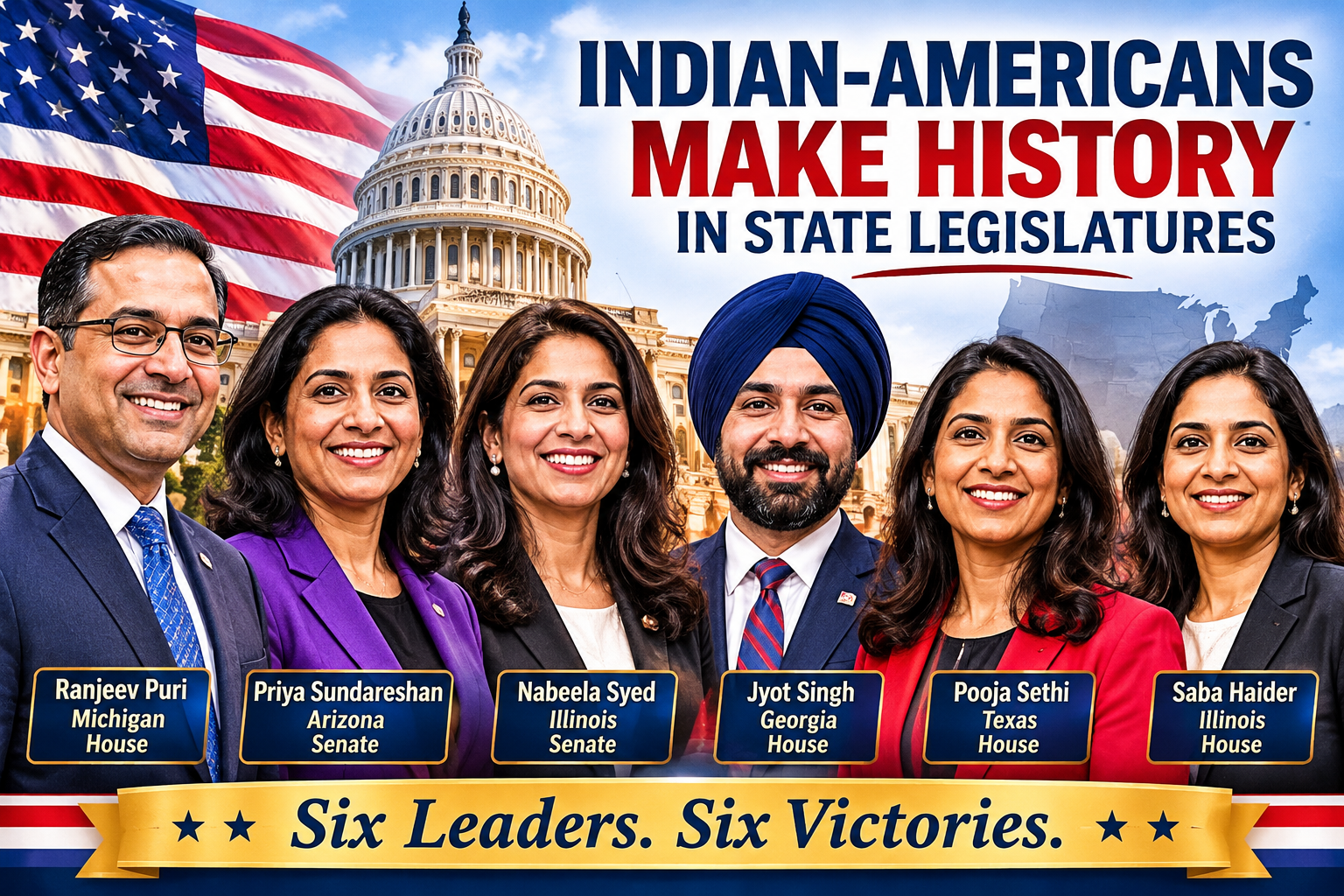
Two of the most prominent victories could lead to Indian-Americans occupying leadership positions in the legislative chambers of Michigan and Arizona.
In Michigan, Democrat Ranjeev Puri, the House Minority Leader, won re-election from the 24th District with approximately 66 percent of the vote. Democrats regained control of the state House, placing Puri in a strong position to become its next Speaker. If elected by his party's caucus, he would become the first Indian-American and Sikh American to hold that prestigious position in Michigan. Puri welcomed the Democratic victory, saying voters had spoken clearly and delivered a Democratic majority in the House.
Arizona also witnessed a historic political shift. Democratic Senate Minority Leader Priya Sundareshan won re-election from Senate District 18 with approximately 66 percent of the vote. Democrats captured both chambers of the Arizona Legislature, creating a Democratic trifecta for the first time in roughly six decades. Sundareshan is expected to seek the Senate presidency, although the final leadership position will depend on the Democratic caucus vote.
Illinois emerged as one of the strongest centers of Indian-American political representation. Nabeela Syed achieved a significant victory in Senate District 26, defeating Republican Darby Hills by approximately 57 percent to 43 percent and helping Democrats flip a Republican-held seat. The contest was among the costliest legislative races in Illinois, with Syed raising approximately $3.2 million compared with Hills' $1.5 million by October. Her victory represents another milestone for the growing Indian-American political community in the state.
India-born Saba Haider won the Illinois House District 84 race with approximately 71 percent of the vote, defeating Republican Brian Scopa. State Senator Ram Villivalam secured re-election with approximately 73 percent, while State Representative Kevin Olickal also retained his seat without opposition.
Several other states recorded notable Indian-American victories. In New York, Democrat Lisa Kaul defeated Republican Rob Rolison in Senate District 39, while Jeremy Cooney secured a fourth term in Senate District 56. Cooney, who was adopted from an orphanage in Kolkata and raised by a single mother, represents an inspiring example of the American dream.
In Minnesota, pediatrician Krish Subrahmanian won Senate District 49 with approximately 63 percent. In Maryland, Amar Mukunda, an engineer with military service experience, won Senate District 39 uncontested. Maryland Lieutenant Governor Aruna Miller also secured re-election on Governor Wes Moore's ticket, which won approximately 63 percent statewide.
In Georgia, Jyot Singh made history by becoming the first Indian-American and first Sikh American elected to the state Legislature. He won House District 97 with approximately 68 percent of the vote. In Texas, Democrat Pooja Sethi won House District 47 with approximately 63 percent, becoming the first Indian-American woman and the first Asian-American Democratic woman elected to the Texas Legislature.
Other successful candidates included North Carolina Senate Democratic Whip Jay Chaudhuri, who won re-election with approximately 75 percent; Pennsylvania State Representative Arvind Venkat, who secured another term; Ohio State Representative Anita Somani; Connecticut State Senator Sujata Gadkar-Wilcox; Wisconsin State Representative Renuka Mayadev; California Assemblyman Ash Kalra; and Washington State Senator Manka Dhingra. In Vermont, Kesha Ram Hinsdale and newcomer Nikhil Goyal also won Senate seats. Several Indian-American candidates in Iowa, Kentucky, Nevada, New Mexico and Washington secured victories without opposition.
Republican candidates also maintained representation. Sabi "Doc" Kumar won re-election to the Tennessee House, while Anil Beephan retained his New York Assembly seat. Meanwhile, some prominent Indian-American candidates faced setbacks. Vivek Ramaswamy lost the Ohio gubernatorial contest to Democrat Amy Acton, receiving approximately 44 percent against her 52 percent. Saritha Komatireddy also lost her New York statewide contest.
Indian-American candidates were successful beyond state legislatures as well. In local government, Salt Lake County District Attorney Sim Gill won re-election, Mona Singh performed strongly in Wake County, and Silky Joshi-Malik won an education board seat in Harris County, Texas. Other Indian-American candidates secured positions in county commissions and local councils.
These victories reflect a broader transformation in the political landscape of the United States. The Indian-American population, estimated at more than five million, has become one of the country's most influential Asian-origin communities. Its members are increasingly visible not only in business, medicine, technology and education but also in public administration and elected office.
The success of these candidates is particularly significant because state legislatures play a crucial role in shaping policies affecting education, healthcare, taxation, immigration-related issues, business regulations and community development. Their presence provides Indian-Americans with a stronger voice in decisions that directly affect their families and future generations.
For a community that arrived in America in successive waves of immigration and gradually established itself through education, entrepreneurship and professional achievement, these electoral victories represent another important milestone. They also demonstrate that political participation is no longer limited to a handful of prominent individuals at the national level.
The message from the November elections is clear: Indian-Americans are increasingly becoming an integral part of America's political leadership. Their growing representation in state legislatures is not merely a matter of community pride; it is evidence of a changing America in which people of diverse backgrounds are helping shape the nation's future.